If you’ve been reading building specifications, energy code requirements or project documents, you’ve probably come across two different terms:
Blower door testing and ASTM E779.
At first glance, they sound like two completely different things. One sounds like a practical field test. The other sounds like a technical standard hidden somewhere in a building code.
So naturally, people ask:
“Are they different tests or are they actually the same thing?”
The answer is simpler than most people expect.
A blower door test is the test itself.
ASTM E779 is the standard that explains exactly how that test should be performed.
Once you understand that relationship, the rest of the terminology becomes much easier to follow.
What Is a Blower Door Test?
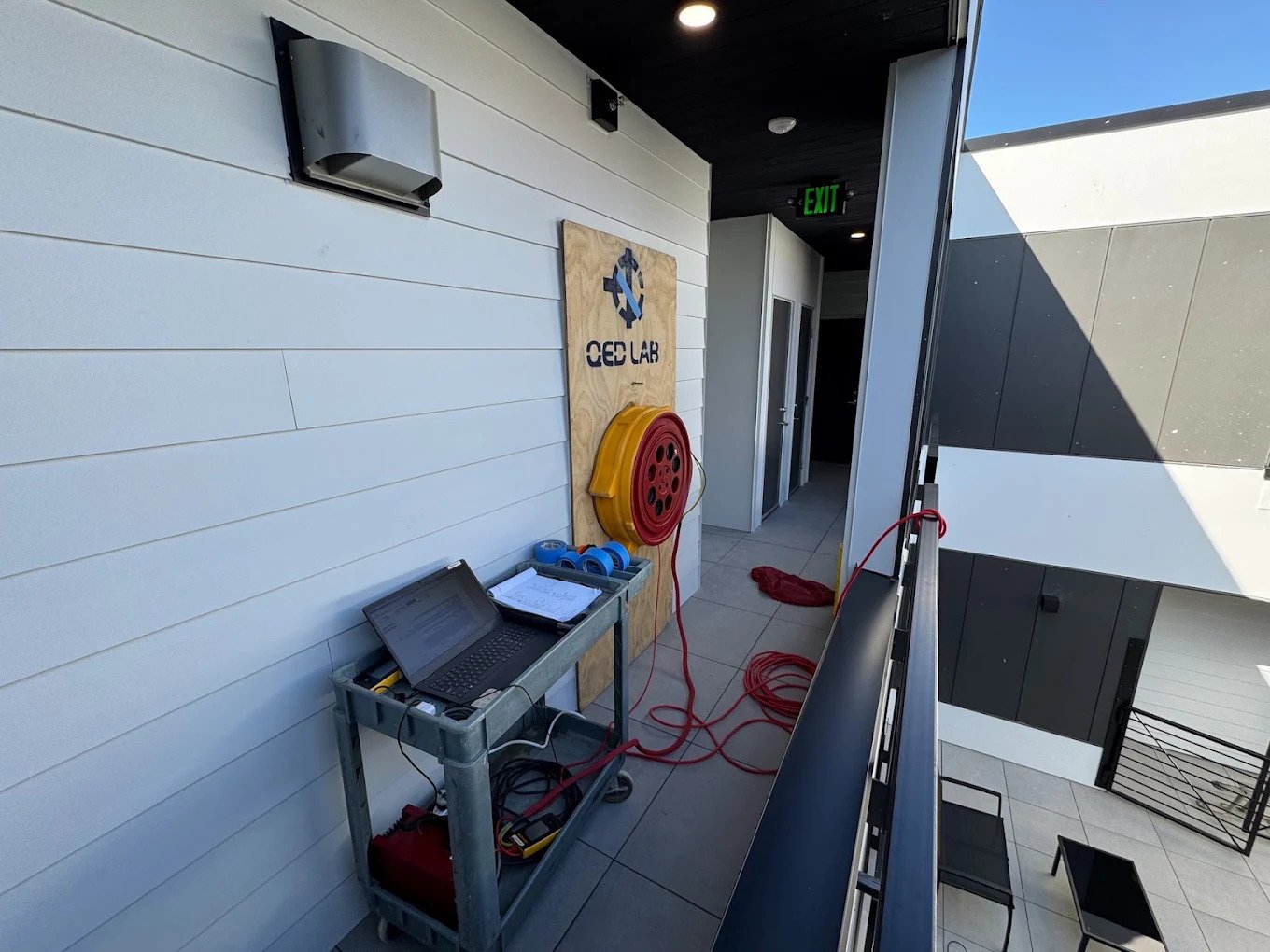 Let’s start with the part most people are familiar with. A blower door test is used to measure how much air leaks through a building’s exterior envelope.
During the test, a calibrated fan is temporarily installed in an exterior doorway. The fan either pressurizes or depressurizes the building while specialized instruments measure how much air moves through cracks, gaps, and other openings.
The result isn’t based on guesswork.
Instead, it provides measurable data showing how airtight or how leaky the building actually is.
That’s why blower door testing has become a standard part of many commercial construction projects, energy code compliance programs and building performance evaluations.
So Where Does ASTM E779 Fit In?
This is where the confusion usually begins. ASTM E779 isn’t another type of air leakage test.
It’s the published testing standard developed by ASTM International that explains how a blower door test should be performed.
Its official title is:
“Standard Test Method for Determining Air Leakage Rate by Fan Pressurization.”
Think of ASTM E779 as the instruction manual.
It tells testing professionals things like:
-
How the blower door equipment should be installed.
-
What pressure levels should be used.
-
How airflow measurements are collected.
-
How the final air leakage rate is calculated.
Following the standard ensures that two different testing companies can perform the same test and produce results that are consistent and comparable.
Without a standardized method, every company could measure buildings differently.
Why Does ASTM E779 Use Multiple Pressure Levels?
One detail that often surprises people is that ASTM E779 doesn’t rely on just one measurement. Instead, it uses what’s known as a multi-point regression test.
Rather than recording airflow at a single pressure, technicians collect readings at several different pressure levels.
Those measurements are then used to create a leakage curve that produces a more reliable picture of how the building performs.
While this process takes a little longer than simplified testing methods, it provides highly accurate and repeatable results, especially for commercial projects.
Then Why Do Some Specifications Mention ASTM E1827?
If you’ve reviewed project specifications, you’ve probably noticed another standard appearing alongside ASTM E779.
That’s ASTM E1827. At first, it looks like a completely different testing method.
In reality, it’s closely related.
ASTM E1827 was developed specifically for orifice blower door equipment, which is commonly used throughout the industry.
It includes simplified testing procedures, including single-point and two-point testing methods, making it faster for certain applications while still providing reliable results.
Think of it like this.
-
Blower door testing is the process.
-
ASTM E779 is the comprehensive testing standard.
-
ASTM E1827 is a streamlined adaptation of that standard for specific blower door equipment.
They’re all part of the same overall testing system rather than competing approaches.
Which Standard Does Your Project Need?
That depends on the project requirements. Some commercial projects, energy codes or certification programs specifically reference ASTM E779.
Others allow ASTM E1827.
The important thing isn’t deciding which standard is “better.”
It’s following the testing method required by your project specifications.
For many commercial buildings where highly detailed leakage data is needed, ASTM E779 remains the preferred methodology.
For smaller projects or situations where faster testing is appropriate, ASTM E1827 may fully satisfy the project requirements.
Reviewing the specifications before scheduling testing helps ensure the final report meets the expectations of the building owner, design team, and code officials.
Why Understanding the Difference Matters
For many building owners and project teams, the terminology can sound far more complicated than it really is.
But once you know the relationship, everything becomes much clearer. You’re not choosing between completely different tests.
You’re simply identifying which testing standard governs the blower door test your project requires.
That understanding makes it much easier to communicate with testing professionals, review project specifications, and ensure compliance with energy codes and performance requirements.
Conclusion
A blower door test measures how much air leaks through a building. ASTM E779 explains exactly how that test should be performed to produce accurate, repeatable results.
ASTM E1827 builds on that same foundation by providing simplified procedures for commonly used blower door equipment.
For more educational articles about blower door testing, ASTM standards, air leakage testing, and building envelope performance, explore the resources available on the QED Lab Inc. website.
What a fantastic spot for players who want a reliable and cheerful experience. I downloaded this app recently and the onboarding felt like meeting a welcoming host. The games load fast and the daily rewards keep the excitement alive. Definitely my go to place for a happy spin. bdyesbetapps
Smooth registration and a library of games that actually deliver on excitement. I really like how they balance classic favorites with newer releases so there is always something fresh to explore. Support is polite and knows exactly how to handle requests. ingoagames
I have been searching for a reliable login portal for ages and finally found exactly what I needed here. The interface is super smooth and I can start playing in just a few taps. Great job keeping things simple and fast for us regulars. hoye55login
[8172]gb 99 Official Login | সেরা অনলাইন স্লট ও ক্যাসিনো গেম,gb 99-এ আজই যোগ দিন। সহজেই অ্যাপ ডাউনলোড করুন এবং বিকাশ দিয়ে নিরাপদ ক্যাসিনো ডিপোজিট করে সেরা স্লট গেমগুলো উপভোগ করুন। এখনই শুরু করুন। visit: gb 99
Super friendly customer support. They helped me out with my deposit issue in just a few minutes. Five stars for phjili188!
Logging in is a breeze and the game loading times are super short. It makes the whole experience so much more enjoyable on pksixgamelogin
Love the promotions they run every weekend. It keeps the gameplay exciting and rewarding. I always suggest ph555taya to my buddies.
Finally found a platform that doesn’t lag during peak hours. The interface at ph68jllogin is super intuitive and easy to navigate.
Honestly, this is one of the most stable sites I have used recently. The loading speed is great and the interface is very friendly for beginners. Highly recommend phjljl7777 for anyone looking for a smooth experience!
Just finished the setup and everything is running perfectly. The installation process was straightforward and the rewards are legit. Go get it at jl777download now.