If you’ve recently received a quote for crane tree removal, your first reaction was probably something like this:
“Wait…it costs how much?”
You’re not alone.
For many homeowners, crane tree removal is something they’ve never needed before. Without any point of reference, a quote of several thousand dollars can feel surprising or even unreasonable.
The good news is there’s usually a very logical explanation behind the price.
Once you understand what goes into a crane-assisted tree removal, the estimate starts making a lot more sense. Let’s break it down.
First Things First: Why Would a Tree Need a Crane?
This is usually the first question homeowners ask. After all, people remove trees with chainsaws every day. So why bring in a crane?
The answer usually comes down to one word:
Safety.
Some trees simply can’t be dropped to the ground the traditional way.
Imagine a large Douglas fir growing directly over your roof. Or a mature oak surrounded by fences, neighboring homes and power lines. There isn’t enough room for heavy branches to fall safely.
Instead of cutting and dropping each section, a crane lifts every piece away from the property before lowering it safely to the ground.
It’s slower, more controlled, and in many situations, it’s the safest option for both the crew and your property.
So Why Does Crane Tree Removal Cost More?
Once a crane becomes part of the project, you’re no longer paying for a standard tree removal. You’re coordinating multiple pieces of specialized equipment and a larger crew.
A typical crane removal often involves:
-
A crane truck that may extend 60–100 feet.
-
A licensed crane operator.
-
An experienced arborist directing the removal.
-
Rigging specialists securing every section before it’s cut.
-
A larger ground crew managing safety and cleanup.
Every additional person and every additional piece of equipment adds time, planning, and cost.
That’s why crane removal isn’t simply “tree removal with a crane.” It’s an entirely different operation.
What Does Crane Tree Removal Cost in Portland?
Every projec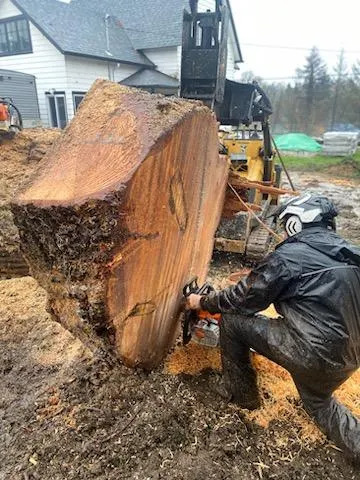 t is different, but most crane-assisted removals fall into a few general price ranges.
Straightforward removals
A large tree with good street access and plenty of working space generally ranges from $1,500 to $3,500.
Moderately difficult projects
Trees growing close to homes, garages, or fences often range between $3,500 and $6,000.
Complex removals
Dead trees, limited access, multi-day projects or trees requiring utility coordination may range from $6,000 to $12,000 or more.
One of the biggest individual expenses is the crane itself.
Depending on the equipment required, crane rental in the Portland area often ranges between $150 and $300 per hour, before labor and cleanup are even considered.
Why Can Two Companies Give Very Different Prices?
This is probably the question that creates the most confusion. You receive two estimates.
Both companies looked at the same tree.
Yet one quote is thousands of dollars higher.
How is that possible?
There are usually several reasons. One company may include stump grinding while another prices it separately.
One may own its crane, while another rents one.
Some companies allow more time for difficult removals because they prefer a slower, more cautious approach. Insurance coverage, licensing, crew size, cleanup and debris hauling can all affect the final price.
That’s why comparing estimates isn’t just about comparing numbers, it’s about comparing what’s actually included.
What Has the Biggest Impact on Cost?
Several factors influence the final price, but these tend to matter the most.
Tree Size
Larger trees require more cuts, more crane time, and more cleanup. A 120-foot Douglas fir is a very different project than removing a 50-foot ornamental tree.
Tree Condition
Dead or structurally compromised trees require additional caution because the wood can behave unpredictably during removal. Safety takes priority and that often increases the time needed to complete the work.
Location
Trees growing over homes, garages, pools, fences or neighboring properties require much more precise lifting than trees standing in open areas.
Even a few extra feet of crane reach can affect the complexity of the project.
Site Access
Can the crane park next to the tree? Or does it need to reach over fences, landscaping, or other structures? The more difficult the access, the more complicated the removal becomes.
Is a Crane Always Necessary?
Not always.
Many trees can still be removed using traditional climbing techniques.
Others benefit from a combination approach, where part of the tree is removed conventionally before a crane is used for the most difficult sections.
That’s why an on-site assessment matters.
A qualified arborist should be able to explain exactly why a crane is or isn’t the safest solution for your specific tree.
If the explanation doesn’t make sense, don’t hesitate to ask questions. A good tree service should be happy to walk you through the decision.
Can You Save Money?
Sometimes, yes. One of the biggest ways homeowners reduce costs is by acting early.
A tree that’s beginning to decline is usually less expensive to remove than one that’s already failed during a storm.
Emergency crane removals often cost significantly more because they involve immediate response, higher risk, and more complex working conditions.
Scheduling an evaluation before storm season can often give homeowners more options and potentially lower costs.
Conclusion
Crane tree removal is one of the most specialized services in arboriculture.
While the price can seem high at first, it reflects the equipment, planning, skilled labor, and safety measures required to remove large trees without damaging nearby homes or putting people at risk.
If you’re comparing estimates, focus on more than just the final number. Ask what’s included, why a crane has been recommended and how the work will be completed.
For more practical articles about crane-assisted tree removal, hazardous trees, storm preparation, and tree care, explore the educational resources available on the Portland Tree Service website.
Really impressed with the game selection here. Everything loads quickly and the graphics are crisp. 98pakgame is definitely a hidden gem.
The jackpots here are insane! I love how easy it is to navigate the site on my phone. Big thanks to phjilihot777 for the awesome vibes.
[7779]23 takabet লগইন ও অ্যাপ ডাউনলোড – বিকাশ ক্যাসিনো ডিপোজিট,23 takabet লগইন করে অনলাইন স্লট গেম কিভাবে খেলবেন তা জানুন। বিকাশ দিয়ে ক্যাসিনো ডিপোজিট এবং লাইভ ক্যাসিনো বোনাস অফার পেতে আজই জয়েন করুন। visit: 23 takabet